
OBD terminology
Ford OBD-II Readiness Monitors Explained
Readiness is the PCM’s record of whether required emissions self-tests have run to completion. It is not a second name for P1000, and it is not a parts diagnosis.
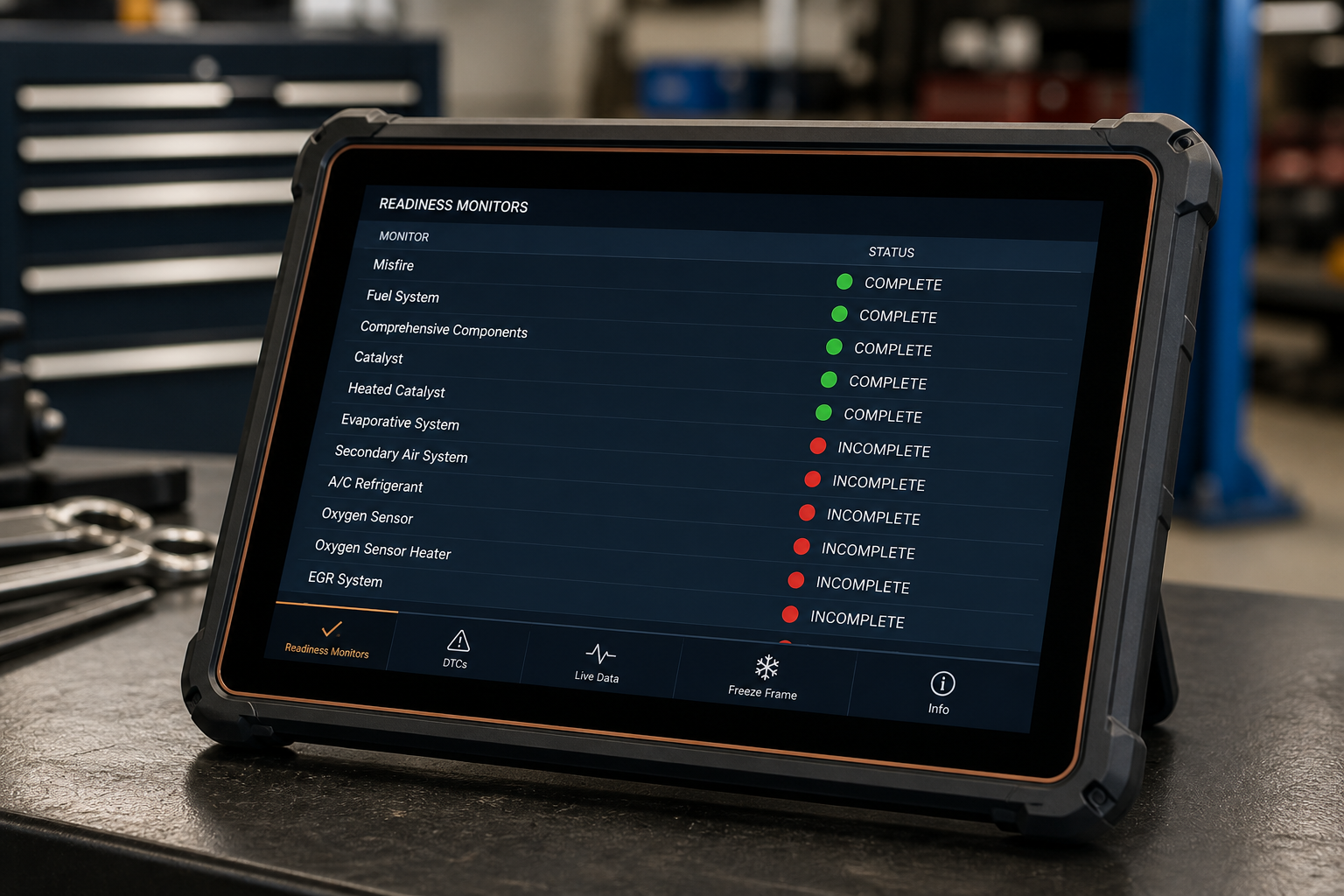
Ready vs not ready
Complete / ready means that monitor’s test has finished for the current cycle. Incomplete / not ready means it has not. Not supported means the vehicle’s calibration does not run that monitor — waiting on it will not help.
Continuous vs non-continuous
Continuous monitors (often misfire, fuel system, comprehensive components) evaluate frequently while the engine runs. Non-continuous monitors (catalyst, EVAP, O2, heater, EGR/VVT, and others when equipped) need specific enable conditions and may take longer after a reset.
Do not assume a universal monitor set
Monitor reference
| Monitor | What it checks | Continuous? | Typical reason for Not Ready | Notes |
|---|---|---|---|---|
| Misfire | Combustion quality / misfire detection while the engine is running | Continuous | Recent PCM reset, or a stored/pending misfire concern preventing completion | Often a continuous monitor. Applicability and enable criteria still vary by calibration. |
| Fuel System | Fuel trim / closed-loop fuel control performance | Continuous | Reset, fuel-system fault, or conditions that keep the system from entering the expected operating mode | A fuel-system DTC can keep related monitoring from finishing even after mixed driving. |
| Comprehensive Components | Inputs/outputs the PCM continuously evaluates for circuit and rationality faults | Continuous | Power-up reset or a component that never meets enable conditions | Name and grouping can differ by scan tool. Confirm against the tool’s Ford PID list. |
| Catalyst | Catalytic converter efficiency relative to the vehicle’s OBD design | Non-continuous | Insufficient catalyst-monitor enable conditions, or a catalyst/O2-related fault | P1000 does not diagnose a failed converter. A catalyst-efficiency DTC is a separate finding. |
| Heated Catalyst | Heated-catalyst function on applications that use this monitor | Non-continuous | The vehicle may not support this monitor, or enable conditions were not met | Not used on every Ford. Unsupported monitors should not be treated as “not ready.” |
| EVAP | Evaporative emission system integrity and purge control, where required | Non-continuous | Fuel level, temperature, cold-start, or a leak/purge concern blocking the test | Frequently the last incomplete monitor. Fuel-level windows are application-specific. |
| Secondary Air System | Secondary air injection operation on equipped vehicles | Non-continuous | Unsupported on many late-model Fords, or enable conditions not met | Do not chase this monitor on vehicles that do not have the system. |
| Oxygen Sensor | O2 / A/F sensor response and performance | Non-continuous | Sensor, wiring, exhaust-leak, or fuel-control issues, or incomplete drive conditions | Heater and sensor monitors are related but not identical. |
| Oxygen Sensor Heater | O2 / A/F sensor heater circuit and performance | Non-continuous | Heater circuit fault or insufficient run time after a reset | A heater DTC can prevent the heater monitor from completing. |
| EGR / VVT | EGR flow or variable valve timing performance, depending on the powertrain | Non-continuous | Flow/timing fault, carbon, actuator issues, or missing enable conditions | Scan tools may label this differently (EGR, VVT, or both). Confirm the Ford PID name. |
Why monitors reset
Battery disconnect, code clear, and PCM reprogramming commonly return non-continuous monitors to not ready. That is expected. One monitor can also lag because its enable window is narrow (EVAP is a frequent example).
Scan-tool interpretation
Labels differ by tool
No. Not ready means the test has not completed. A failed test typically stores a different DTC.

This site provides general diagnostic information. Vehicle procedures vary by model, year, engine, and calibration. Follow Ford service information and local regulations, and use a qualified technician when diagnosis or repair exceeds your experience.